Trash Talk: The Sanitation Worker Who Taught America's Archaeologists Everything They'd Missed
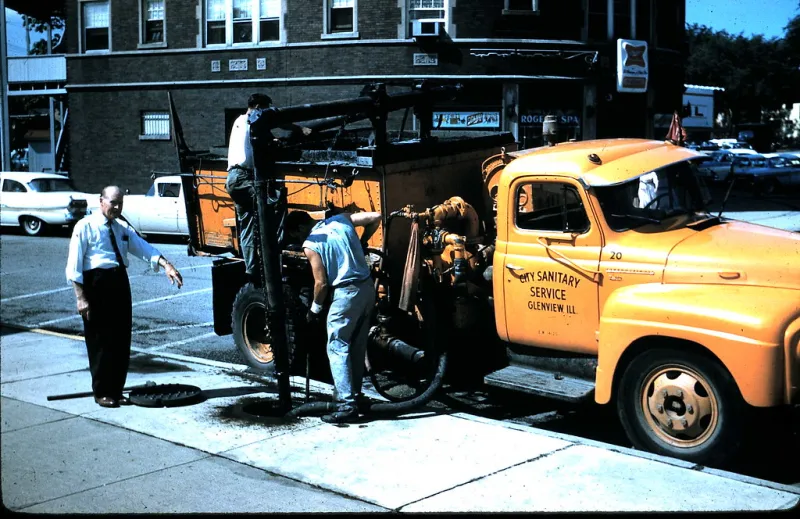
Photo: vintage sanitation worker city street 1960s urban America, via live.staticflickr.com
Trash Talk: The Sanitation Worker Who Taught America's Archaeologists Everything They'd Missed
There's a version of history that gets written in lecture halls, funded by grants, and published in journals that maybe three hundred people read. Then there's the version that gets written in alleyways, at the back of garbage trucks, in the margins of notebooks kept in a worker's locker at a municipal sanitation depot.
For a long time, those two versions didn't talk to each other.
That changed because of one man who spent his working life doing a job most people don't think twice about — and who used that invisibility to see things no credentialed researcher ever could.
The Education Nobody Planned
He hadn't set out to be anything other than employed. Like a lot of young men in mid-twentieth century urban America, he took the work that was available. Sanitation paid steadily, offered benefits, and came with a kind of social contract: you showed up, you did the job, the city kept running. It wasn't glamorous. Nobody was writing feature stories about it.
But somewhere in the early years of his route, something clicked. He started noticing patterns in what people discarded — not in a vague, philosophical way, but with a precision that would have impressed a trained scientist. He began keeping notes. Then logs. Then, eventually, something that looked a lot like a systematic catalog.
What he was building, without knowing the academic term for it, was a material culture archive. A record of everyday life assembled not from what people said they did, but from what they actually threw away.
And those two things, it turns out, are very different.
What the Textbooks Missed
American archaeology in the postwar decades was largely focused outward — on indigenous sites, on colonial-era settlements, on the deep past. The idea that the present, or the near-present, might be equally worth studying hadn't fully taken hold. When researchers did look at contemporary life, they relied on surveys, interviews, and self-reported data. They asked people what they bought, what they ate, how they lived.
People lied. Not always on purpose — sometimes they just remembered wrong, or reported what they wished were true rather than what was. A family might describe a diet heavy in vegetables and light on processed food. Their garbage told a different story.
This gap between self-report and material reality was exactly what his notebooks documented, route by route, block by block, year by year. He tracked what got thrown out by neighborhood, by season, by household type. He noticed that consumption patterns in working-class Black neighborhoods differed sharply from what those same communities reported in census surveys — partly because the surveys were badly designed, and partly because the questions themselves carried assumptions that didn't fit the reality on the ground.
He noticed that certain products disappeared from wealthy neighborhoods years before they appeared in middle-income ones. He noticed that waste from immigrant communities followed distinct cycles tied to cultural calendars that no mainstream researcher had thought to account for.
He was building a portrait of America that was more honest, more granular, and more uncomfortable than anything being produced in the academy.
The Moment the Academy Noticed
The reckoning came gradually, the way most reckonings do — not as a single dramatic confrontation, but as a slow accumulation of moments where the official version of events didn't hold up.
A researcher working on urban consumption in the 1970s kept running into data that didn't match what her fieldwork predicted. A colleague suggested, somewhat dismissively, that she talk to someone in the sanitation department who apparently kept records. She expected to spend an hour being polite. She spent three days going through his notebooks instead.
What she found was decades of primary source material that no university archive contained. She brought in colleagues. They brought in more colleagues. The man who had been driving a truck for twenty years found himself sitting across from people with PhDs, answering questions about methodology — and, more often than not, pointing out where their frameworks were wrong.
He was patient about it. He'd had a long time to think.
What He Actually Proved
The deeper contribution wasn't just the data, remarkable as it was. It was the methodological argument his work made without ever intending to: that access shapes knowledge, and that the people society renders invisible often see the most clearly.
University-trained archaeologists had access to grants, publications, and conferences. They did not have access to the back alleys of American cities at six in the morning, five days a week, for thirty years. He did. And that access produced a kind of knowledge that couldn't be replicated in a lab or constructed from a survey.
The race and class dimensions of his findings were particularly striking. His records showed, in concrete material terms, how differently American consumer culture was experienced across racial lines — not as a political argument, but as a factual catalog of what got bought, used, and discarded. Researchers who had been trying to make this case through interviews and economic data suddenly had something far more difficult to dismiss: the actual garbage.
The Unlikely Legacy
He never held an academic position. He never published in a peer-reviewed journal under his own name. He retired from the sanitation department the same way he'd worked it — quietly, without ceremony.
But the field that eventually emerged partly from his work — the archaeology of the contemporary past, sometimes called garbology in its more popularized form — carries his fingerprints all over it. Researchers who built careers on studying material culture in living communities were, in many cases, working from frameworks that a garbage man had sketched out in a composition notebook decades before they got there.
That's the thing about unlikely contributions. They don't always arrive with a press release. Sometimes they arrive at the back door, before dawn, in the form of someone doing a job nobody celebrates — and paying closer attention than anyone thought to ask.
The garbage was always telling the truth. He was just the first one listening.