The Catch That Changed Everything
Captain Jake Morrison knew something was wrong with his nets before he even hauled them aboard. The Sarah's Dream was working the same waters off Cape Hatteras where his family had fished for three generations, but instead of the familiar weight of a good catch, his nets felt strange — heavy in the wrong way, full of objects that scraped and clinked against each other like broken dishes.
What came up that September morning in 1983 wasn't fish. It was pottery. Dozens of ceramic fragments, carved stone tools, and what looked like pieces of carved bone ornaments. Morrison had been fishing these waters for fifteen years and had never seen anything like it.
Most captains would have cursed the lost fishing time and thrown the debris overboard. Morrison loaded it into empty bait buckets and took it home.
The Fisherman's Filing System
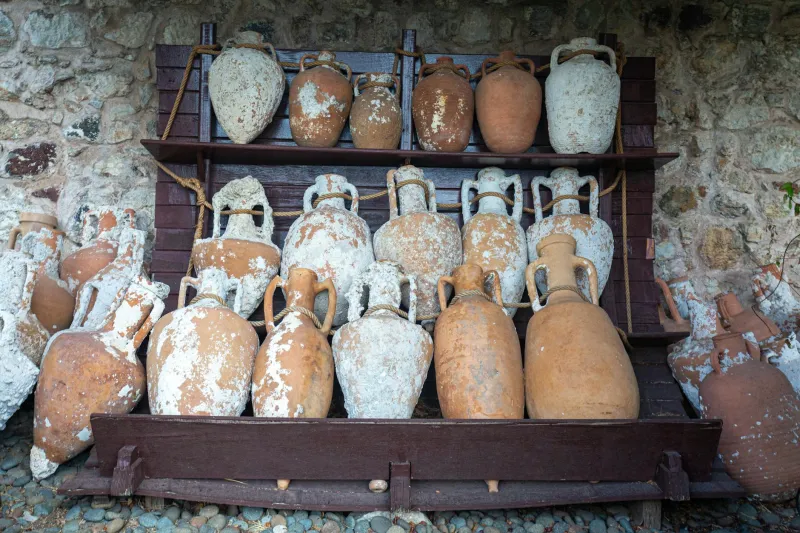
Morrison's garage in Buxton, North Carolina, slowly transformed into something between a maritime museum and an archaeological laboratory. He built shelving systems from lobster traps and fishing net frames, creating a cataloging system that would have impressed any university researcher.
Every artifact was photographed, measured, and logged with GPS coordinates from where his nets had found it. Morrison taught himself to use a 35mm camera, shooting hundreds of rolls of film to document each fragment. He recorded water depth, current conditions, and tidal states for every recovery location.
"People thought I was crazy," Morrison later recalled. "My wife kept asking when I was going to throw out all that broken pottery and get back to fishing."
But Morrison couldn't shake the feeling that the objects were trying to tell him something. The pottery fragments showed sophisticated craftsmanship — geometric patterns and firing techniques that seemed far more advanced than anything he'd learned about pre-colonial Native American cultures in the region.
Twenty Years of Patient Obsession
Morrison's collection grew with each fishing season. He modified his nets to catch artifacts without damaging them, and began keeping detailed charts of underwater topography based on what his nets encountered. Slowly, a pattern emerged.
The artifacts weren't randomly scattered across the ocean floor. They clustered in specific areas that formed rough geometric shapes — patterns that suggested the remains of structures. Morrison began to suspect he had found the remnants of a submerged settlement.
He spent winters researching at the local library, teaching himself about archaeology, oceanography, and pre-colonial American cultures. He corresponded with university professors, most of whom politely dismissed his theories. A commercial fisherman with a high school education wasn't supposed to make archaeological discoveries.
The Evidence Becomes Undeniable
By 2003, Morrison had cataloged over 3,000 artifacts from a two-square-mile area of the ocean floor. His garage contained the largest collection of underwater archaeological material ever assembled by a single individual. More importantly, his meticulous documentation had revealed something extraordinary.
The artifacts weren't just evidence of human habitation — they suggested a sophisticated coastal civilization that had existed for centuries before European contact. Carbon dating of organic materials placed some artifacts at over 800 years old. The settlement appeared to have been gradually submerged by rising sea levels and coastal erosion.
When Morrison finally convinced Dr. Sarah Chen, a marine archaeologist at East Carolina University, to examine his collection, she was stunned. "This represents twenty years of methodical underwater archaeology conducted by someone who had no formal training but understood the work better than most graduate students," Chen later wrote.
Rewriting the Coastal Story
Morrison's discovery forced archaeologists to reconsider the history of the Atlantic coast. The submerged settlement showed evidence of advanced pottery techniques, sophisticated tool-making, and complex social organization that predated European contact by centuries.
The site, now known as the Hatteras Submerged Cultural Landscape, has become one of the most important underwater archaeological sites in North America. Morrison's fishing boat became the platform for official excavations, and his garage collection formed the foundation for ongoing research.
"Jake Morrison did something that academic archaeology often fails to do," explains Dr. Chen. "He paid attention to what the ocean was trying to tell him, and he had the patience to listen for twenty years."
The Unlikely Archaeologist
Morrison never stopped fishing, but his nets now serve a dual purpose. He continues to work with university researchers, using his intimate knowledge of local waters and weather patterns to guide underwater excavations. His fishing logs have become archaeological documents, and his modified nets are used by researchers studying other underwater sites.
The man who started collecting broken pottery because it seemed interesting has fundamentally changed how archaeologists think about pre-colonial coastal settlements. Morrison's story proves that some of the most important discoveries come from people who are simply paying attention to what others overlook.
The Sea's Secrets
Morrison's garage still houses thousands of artifacts, though many have been transferred to university collections for study. The walls are covered with charts, photographs, and maps that document two decades of patient investigation. In the center of it all sits Morrison's original fishing logbook, where he first recorded the strange catch that started everything.
"The ocean doesn't give up its secrets easily," Morrison reflects. "But if you pay attention long enough, it will tell you stories you never expected to hear."
The fisherman who caught history in his nets reminds us that curiosity and persistence can be more valuable than formal credentials. Sometimes the most important discoveries are made by people who are simply doing their jobs with extraordinary attention to detail.
Morrison's twenty-year conversation with the sea floor has revealed a lost chapter of American history. The nets that were supposed to catch fish instead caught something far more valuable: evidence of a civilization that time and tide had nearly erased forever.