The Secret Artist: How 400 Hidden Paintings Turned a Filing Clerk Into an American Master
The Discovery That Stunned Manhattan
The call came on a Tuesday morning in March 2019. Patricia Brennan was still sorting through her late father's belongings when Sotheby's senior appraiser practically whispered into the phone: "Ma'am, you need to sit down."
What they'd found in Harold Brennan's basement wasn't just a collection—it was a revelation. Four hundred paintings, perfectly preserved, spanning four decades of work that no living person had ever seen. Within hours, the art world was buzzing about the "Brennan Discovery," a trove of American folk art that would soon redefine how we think about hidden genius.
The man who created it all had spent forty years filing insurance claims in downtown Hartford, Connecticut. His coworkers knew him as quiet, reliable Harold—the guy who brought tuna sandwiches to work and never missed a day. They had no idea they were having coffee with one of the most prolific artists of his generation.
The Double Life of Harold Brennan
Every evening at 5:30 PM, Harold Brennan would walk the same route home from Mutual Assurance Company, past the bus stop where he could have caught a ride, past the diner where his colleagues sometimes grabbed dinner. The twenty-minute walk wasn't about exercise—it was his transition ritual, the bridge between Harold the clerk and Harold the artist.
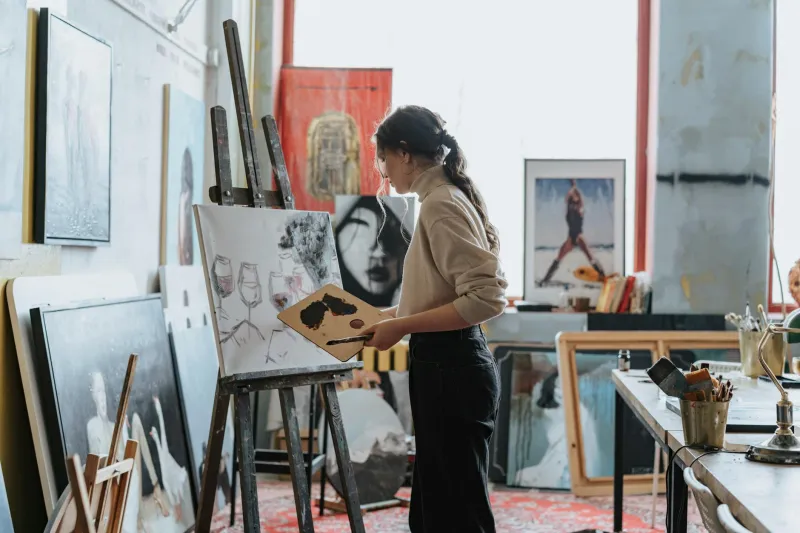
His basement studio was a world apart from the fluorescent-lit office where he spent his days. Canvases lined every wall, some finished, others abandoned mid-brushstroke. Mason jars filled with turpentine and linseed oil sat next to coffee cans bristling with brushes. The single window had been painted black decades earlier—Harold worked by lamplight, even in summer.
"He'd disappear down there right after dinner," remembered his neighbor, Dorothy Walsh. "We'd see the light under the door until well past midnight. I always figured he had a workshop, maybe built furniture. Never imagined... well, this."
Painting for an Audience of One
What drove a man to create hundreds of paintings with no intention of ever showing them? The question haunted art critics as they studied Harold's work in the months after the discovery. His paintings revealed an artist in constant dialogue with himself—each piece building on the last, techniques evolving, themes deepening.
His early work showed clear influences from the Hudson River School, but by the 1980s, Harold had developed a style entirely his own. His landscapes weren't just representations—they were emotional territories, painted with a intensity that suggested each canvas was a conversation he couldn't have anywhere else.
"There's something almost confessional about these paintings," observed Dr. Sarah Martinez, curator of American Art at the Whitney Museum. "You can feel the artist working through ideas, emotions, entire philosophies of life. It's like reading someone's diary, except the language is color and light."
One series, painted entirely in shades of blue and gray, seemed to capture the isolation of his double life. Another, bursting with reds and golds, suggested moments of pure joy that he apparently never shared with another living soul.
The Art World's Best-Kept Secret
When Sotheby's announced the Harold Brennan estate sale, the art world took notice. Here was an artist completely outside the gallery system, the academic networks, the social circles that typically produce "discovered" masters. He'd never submitted to a show, never sought a patron, never even signed most of his work.
The auction, held on a crisp October evening in 2019, drew collectors from around the world. Lot after lot exceeded estimates as bidders competed for pieces by an artist they'd never heard of six months earlier. The final tally: $2.3 million for a collection that had been created in complete secrecy.
"I've been in this business for thirty years," said auctioneer James Whitfield, "and I've never seen anything like it. Usually, when we discover an unknown artist's work, there are gaps, inconsistencies, pieces that don't quite work. Harold's collection is remarkably mature—like he spent forty years having a conversation with himself about what art could be."
The Mystery of Motivation
Perhaps the most intriguing aspect of Harold's story isn't what he painted, but why he painted in secret. His daughter Patricia, now the keeper of his artistic legacy, has spent months trying to understand her father's motivations.
"He wasn't shy," she insists. "He had opinions about everything—politics, baseball, the weather. But when it came to his art, it was like he'd built this completely separate world that belonged only to him."
Some art historians theorize that Harold's secrecy was protective—that he understood his art was too personal, too raw for public consumption. Others suggest he was simply following his own creative compass, freed from the pressure to sell, please critics, or fit into established movements.
"Maybe that's exactly why the work is so powerful," suggests Dr. Martinez. "Harold never had to compromise his vision for anyone else's expectations. He was the only audience that mattered."
A Legacy Written in Paint
Today, Harold Brennan's paintings hang in private collections across the country. The Whitney acquired three pieces for its permanent collection. Art schools use his work to discuss the nature of artistic motivation and the relationship between artist and audience.
But perhaps Harold's most important legacy isn't in museums—it's in the basement studios and spare bedrooms where other secret artists continue creating, driven by the same mysterious compulsion that kept a Hartford insurance clerk painting until well past midnight, year after year, for an audience of one.
In a world where art is increasingly about brand and visibility, Harold Brennan reminds us that the most powerful creative impulses often flourish in silence, away from galleries and critics and market forces. Sometimes the most profound artistic conversations are the ones we have entirely with ourselves.
His story raises a haunting question: how many other Harold Brennans are out there right now, creating masterpieces in secret, driven by nothing more than the need to transform the world inside their heads into something they can see?