The Doctors Said Her Racing Days Were Over. Her Body Didn't Get the Memo.
The Doctors Said Her Racing Days Were Over. Her Body Didn't Get the Memo.
The medical verdict came on a Wednesday. Claire Duvane remembers the day of the week because she'd had a good workout that morning — her best in months, actually — and she was still riding that quiet, private satisfaction when the radiologist walked in with the scans.
A compression fracture. Two herniated discs. Significant nerve involvement at L4 and L5. The prognosis, delivered with the particular gentleness doctors use when they've practiced delivering bad news, was unambiguous: competitive athletics was no longer an option. Walking without pain would require time, management, and realistic expectations.
She was twenty-six years old. She'd been training for the Olympic Trials in the 1500 meters.
She thanked the doctor, got in her car, and cried for approximately forty-five minutes. Then she drove to the library.
What "Never" Actually Means
Here's what the medical community knew in the mid-2000s about spinal recovery and elite athletic performance: not enough. Here's what it knows now: considerably more, though still not everything.
The prognosis Duvane received wasn't wrong, exactly. For most people with her specific injury profile, returning to elite competition would be extraordinarily unlikely. The problem with most people, as any statistician will tell you, is that it leaves room for other people.
Duvane spent the first two years doing what she was told — rest, physical therapy, anti-inflammatories, careful walks around her Richmond, Virginia neighborhood that felt nothing like the six-mile tempo runs she'd built her identity around. She gained weight. She lost sleep. She went through what she describes, without drama, as "a pretty standard grief process, just for a life I was still technically living."
The turn came not from a single revelation but from a slow accumulation of questions she couldn't stop asking.
The Unconventional Road Back
In 2009, Duvane encountered a sports medicine researcher named Dr. James Correa at a rehabilitation conference she'd attended more out of desperation than hope. Correa was presenting early findings on what he called "neuroplastic athletic recovery" — the idea that the nervous system's capacity to rewire itself around injury sites had been dramatically underestimated in standard rehabilitation models.
His research wasn't mainstream. Some of his peers were skeptical. Duvane didn't care about mainstream.
She became one of his informal case studies over the next eighteen months. The protocol was unlike anything her previous physical therapists had recommended: water-based resistance training at specific temperature gradients, a progressive loading program that looked dangerously aggressive on paper but was calibrated precisely to her neurological response patterns, and — perhaps most controversially — a return to actual running far earlier than conventional wisdom suggested.
"The traditional model treats the injured structure as the problem," Correa would later explain in a paper that finally got mainstream attention in 2015. "We were learning to treat the nervous system as the solution."
Duvane fell down a lot in the early stages. She set back her progress twice with minor re-injuries that sent her back to square one. She kept going.
The Science of Getting Older and Better
There's a subplot to Duvane's story that the sports science community finds almost as interesting as her recovery: she came back faster than she'd been before the injury.
Not immediately. Not even close, at first. But by her mid-thirties, competing in smaller regional events she'd entered almost as personal experiments, her times were approaching and occasionally matching her pre-injury personal bests. At an age when most distance runners are winding down, she was trending the other direction.
This is less impossible than it sounds, though it remains genuinely surprising. Research on masters athletes — competitors over thirty-five — has increasingly shown that aerobic capacity and muscular efficiency don't decline on the steep curve we assumed. Factors like training intelligence, mental regulation of effort, and the neurological efficiency that comes from decades of movement patterns can, in specific circumstances, offset the physiological losses of aging.
Duvane had also, during her years away from competition, become a meticulous student of her own body in ways she hadn't been as a young athlete running on talent and instinct. She knew her recovery windows, her nutritional triggers, her injury warning signs. She trained smarter because she had no choice.
"Young athletes run through signals their body is sending," she said in a 2022 interview. "I learned to actually listen. Turns out the body's been talking the whole time."
The Starting Line at 38
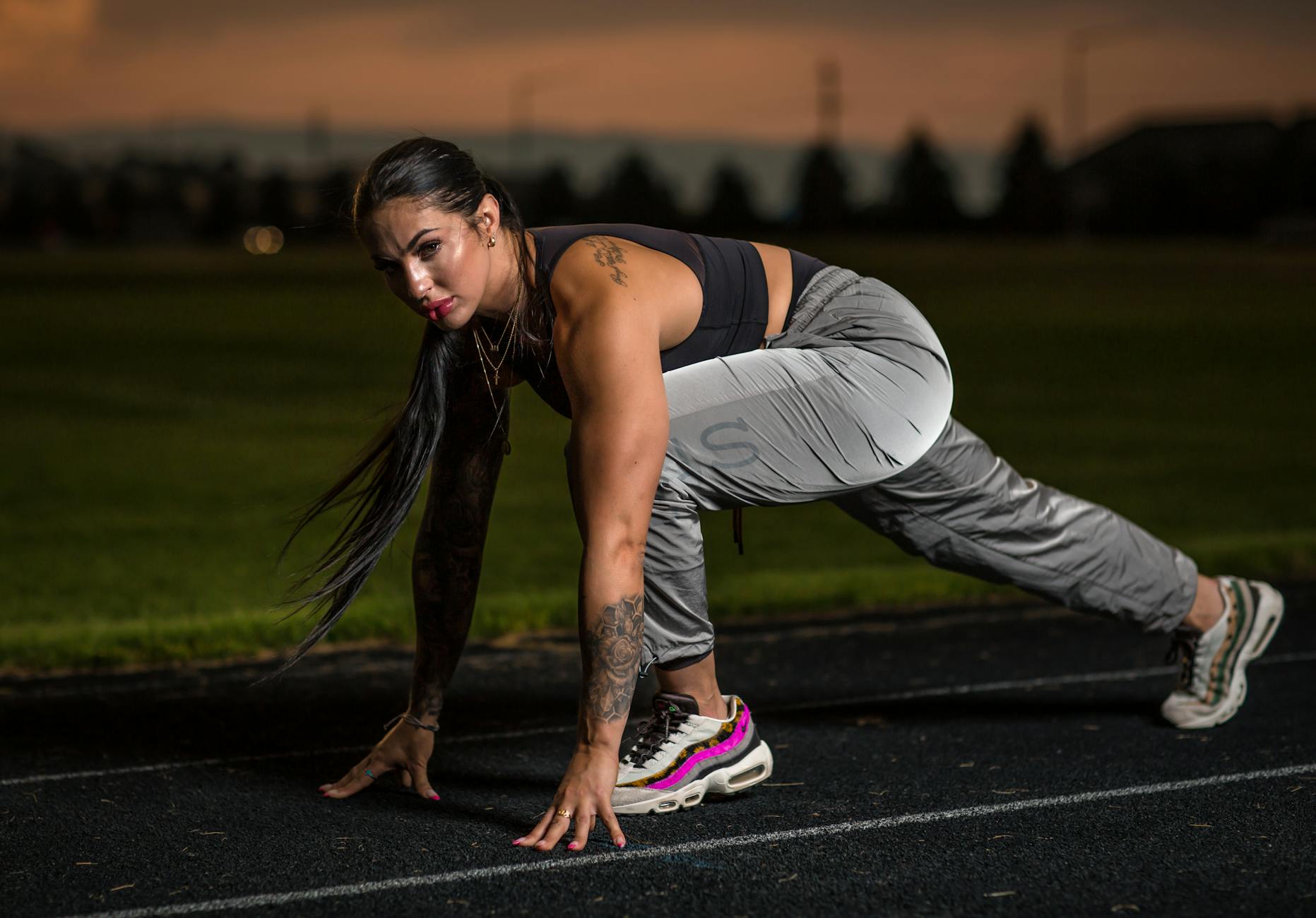
The morning of the Olympic Trials qualifier, Duvane warmed up next to women twelve years her junior, which is a gap that feels entirely different in athletics than it does at a dinner party.
She didn't medal. She didn't make the final team. What she did was finish, legitimately, in a field that the medical establishment had told her she'd never be standing in.
The response online — and this is the part that surprised her most — was enormous. Not because people love an underdog, though they do. But because something in her story touched a nerve that had nothing to do with running.
Most of us have received some version of a verdict. A doctor, a teacher, a hiring manager, a partner — someone who looked at the available evidence and told us what we were and weren't capable of. Most of those verdicts contain some truth. None of them contain all of it.
Duvane's race didn't prove that medicine is wrong. It proved that medicine describes populations, not individuals. And that sometimes, the most important variable in any prognosis is whether the patient has decided to become an outlier.
She's training again. She's forty now. She hasn't told anyone what she's training for.